Surprise, surprise; I actually made progress on various fronts this week. Settle down everybody, I do manage to eek out a little elbow grease and actually work on things every now and again. I managed to work with my SFX editor this week and added a new effect and fixed an old one. In O’ Speak of Your Fleeting, Prolonged Decay! a bottle drops to the ground and breaks open, causing a character to get sick and die. But it wasn’t obvious that the bottle was releasing toxic gas or some deadly, radioactive material (I never really decided which may or may not have contributed to the confusion). To fix this, we added in a light gas effect just as the bottle drops. It feels realistic and it’s not so obvious to take anyone’s attention away from the story. We also spent several hours fixing the old effect which only plays for three seconds. Altogether, we spent half a day working on eight seconds of footage.
I recently got better quality archival footage. Some of it was the exact same footage I already had so I just subbed in those clips, but I found more interesting A-bomb explosions and implemented those where possible. I kept the duration of clips the same, but I sped them up which adds a sense of chaos to the end of my final montage. I sorta stumbled upon that while I was playing around but I think it works extremely well and I like it better than the older version.
Other than that, I’ve been farting around. I’ve watched a lot of Luis Bunuel films and I enjoyed his more surrealist films, but I just didn’t get That Obscure Object of Desire. I thought it was boring and every bit of praise I saw for it just didn’t connect with me. But The Phantom of Liberty started out in the same manner for me, but I’ve grown to like it more and more. Welp, that’s all for this week. Maybe I’ll have something real juicy for you once classes start up.
You probably thought I would take time off my blog, didn’t you? Well, it’s not as if I’d be leading an interesting life where I do interesting things that tear me away from this computer screen. Ha! As if. I’ve been watching a lot of films for my film major final exam and I’m always happy to rediscover how good the classics are. The Apartment is absolutely a masterpiece. It’s amazing to me how good the dialogue is and how the jokes just keep coming. Wilder was so good at creating character out of dialogue that it astounds me. Anyone who says character is only created in reaction to conflict needs to watch this movie. Although dialogue is never pointless, Wilder surely loves to linger in conversations. Plus, any person whose heart doesn’t swell when Fran tells Baxter to shut up and deal just doesn’t have a heart.
I’ve also been applying to a lot of jobs via linkedin. Its the lazy man’s way, sure, but it’s the best I’ve got at the moment. I’m still fixing up the thesis to send to festivals, but that’s slow coming these days. Well, that’s my quick update for this week. Between tons of cooking and baking and watching the films, I haven’t had much time to do anything else. Besides, it’s been snowing outside for the past two days.
I enjoy a good caper. Vodka and cranberry juice? I’m in. And they pair really well with heist films. Recently, I’ve watched a lot of them, but the Ocean’s trilogy and Jean-Pierre Melville are most prominent in my thoughts. According to Roger Ebert, Bob Le Flambeur is the film that put heist films in their own genre. Although I was neutral on the film overall, I do think that it’s full of interesting moments. In a way, we get the scenes of amassing a crew like in Ocean’s or even Seven Samurai. And we also learn about the plan before it happens. Many of these elements work well, but plenty of them have become cliche or some would just call them classic genre conventions.
Telling the plan before it happens is one such convention. Although it doesn’t happen in every movie, it does happen in most. I think this relates to the preference between suspense and surprise. If we know the plan beforehand, then we have knowledge and knowledge equals suspense and tension if we can see a new obstacle getting in the way of that plan. But the lack of knowledge can lead to a shock when we get to see what happens. Often, heist films involve some unforeseen complication during the heist causing our heroes to improvise which is only apparent when we already know the plan. The point being: for a tense heist you have to know something ahead of time. And it doesn’t just have to be the actual plan, it could just be the goal which could be enough for the audience to understand some of the twists and turns that the plot takes.
I absolutely loved Le Cercle Rouge. I will rather sheepishly admit that I originally thought the movie was about one character and the film was jumping around in time, so it took me a bit to realize that there were two main characters all along. Moving along, there are so many moments of pure cinema in this film. The actors have that perfect Melville coolness and they evoke so much with just a glance (which makes me wonder if Refn is a fan of Melville given the cool and quiet protagonists of Drive, Only God Forgives, and ValhallaRising). The actual heist is amazing and tense and I think it could only exist in the film medium. A video game could come close, but often the tension of traditional games are lost if the fail state is reached; whereas, you can gain more tension in a film if the protagonists fail.
But the thing I enjoy most about heist films is when the thieves have a code. Cinema about people who have a job and do it well appeals to me. The ability to carry out a process and take it to its completion just makes for a good film. Look at There Will Be Blood, Upstream Color, Micheal Clayton (which would be much better if we had seen Clooney doing his job more), and heist films which are workplace dramas in a way (maybe that’s a little farfetched but this is my blog and we play by my rules here). AS Brad Pitt says in Moneyball (another great movie about a person who can do their job well) “This is a process. It’s a process, it’s a process. Okay?” So thieves who know what they’re doing and we can trust them to do it instead of breaking into chaos absolutely enthralls me. The Ocean’s crew have “shaken the hand of Sinatra” and that’s enough for them to trust one another. Even a film like Heat involves a code. One of the greatest moments in all of cinema is DeNiro walking away when he feels the heat coming at the end. I like people who stick to their codes. Perhaps this is another reason why I love Le Cercle Rouge so much. Almost wordlessly, we learn the codes of the characters. Both of the men we meet are criminals but they trust each other with their lives. Alain Delon even puts his life in danger, trusting that the stranger hiding in his trunk will know how to dispatch the antagonists. Heist films are the best for this, but people who live by a code pop up in other genres. You just don’t get many Alain Delons in horror films though.
And now time for everyone’s favorite: The Weekend Update! I emailed a company with some footage I could use in my thesis but then they asked for quite a bit of money, none of which I have. But they were super helpful and steered me in the direction of some other footage I might be able to get. Here’s their website if anyone’s interested. Besides that, I’ll be on break for the next two weeks so I’m going to try to finish up my film and continue writing The Maillard Reaction. Thanks for reading what is basically me gushing about heist films.
I’ve wanted to write and direct films for a long time. When I was younger, I devoured films and tried to copy each one. I spent hours every day reading about film theory and watching interviews with directors, writers, cinematographers, and the like. But I didn’t make many films. That’s not entirely truthful, but the quality of those shorts were shameful to me back then. I realize now that everyone makes garbage in the beginning because you just have to. That’s what I tell myself at least.
Today and every day like it, I wonder why I want to make films. I’ve seen what a real film production looks like and all of the work behind the camera. Screenplays, even if they credit one person, are written by committee. Deals are struck to get someone to act in your film, only for them to drop out later. You lose locations and crew in the exact same manner. When you finally get to shoot, you’re busy worrying about a combination of being efficient because you can’t waste anyones time and actually getting the shot. But then someone forgot headphones, batteries, and a work ethic and this becomes your product. You end up literally spending the entire day on your feet, except for your 30 minute lunch break. You go home late and immediately head to bed because you’re too tired to think and you’ve got to wake up early the next morning to do the whole thing over again. After all this hard work, your only thought is that you have to hide all of your mistakes in the edit. Finally, you sit down to watch your finished project but you can’t enjoy it because you notice nothing but those mistakes from earlier. This has been all of my student films.
Filmmaking is scary. I need to make money and this is not the way to do it. Nobody wants to listen to what I have to say and why should they pay to do it. I’m burnt out from my thesis and I haven’t had an idea for a short film I could make in months. The directors I admire never complain, they just do. I’m not able to push myself to come up with ideas and I can’t waste people’s time filming something awful. The older I get the more responsibilities I have. That’s the difference between now and when I was younger.
To do anything else with my life would be to bankrupt my soul. That’s it. Filmmaking is all I’ve got. I just have to do it and I can’t exactly say why. As awful as I made it sound, I love the chaos of the set; I revel in the pressure squeezing me from every side. Every frame of every godawful movie I’ve ever made has been a frame of catharsis for me. Each is some demented part of myself trying to get out and stay out. The doubts I have about my skill and my future remain long after any film wraps and the cast and crew shuffle home, but maybe that’s why I keep making movies.
I do not know what’s next for me. I have trouble working on more than one thing at a time and I’ve been concentrating on The Maillard Reaction quite heavily. As miserable as I may appear from this dumb post, I still have some amount of hope. And I’m itching to make something before I go stark mad.
The maillard reaction is a chemical reaction that proteins in food go through. Foods like steak, coffee beans, and bread all go through this when they reach a high enough temperature. This is why people go nuts when it comes to searing a steak or making sure a loaf of bread browns properly. You see, this reaction is the reason for the food you love tasting so good. During this chemical reaction, many things occur to make the flavors pop. Part of the maillard reaction is caramelization, a process where sugar becomes acidic. Acidity often makes the flavors of a dish shine and so the crust on your steak is changing in such a way that it makes everything around it more delicious. But the most amazing part to me us that scientists don’t know everything that goes on during the maillard reaction. It’s fascinating.
The Maillard Reaction is a television show I’ve been working on for some months now. It’s about a boy, Lazlo Maillard, who has white hair and has been homeschooled during the 1940’s. He accidentally becomes a bus boy at an underground restaurant only known to the most passionate food lovers around the world. The restaurant is run by Auguste Savour and Julius Lard and is of course named Lard and Savour. Anyways, Lazlo is thrown into a world which he doesn’t understand and is forced to keep pace with the gigantic kitchen staff. They are preparing a very important feast for the Truffle Troupe, an underground food organization with unknown motivations. Lazlo accidentally cooks a dish and the crew discovers that he may have special powers allowing him to transfer his thoughts to anyone who cooks something he makes. Around this time, the henchmen of Mr. Squishy, an American fast food chain, attack the restaurant. Despite their best efforts, the chefs are defeated and must retreat to their home countries. As the building is burning down, Savour tasks Lazlo with delivering a secret package to an unknown location. Lazlo runs away as the building crumbles behind him only to find that the entire town is on fire. He returns home to find that his father has disappeared and grabs the only things he can, a book bag and his stuffed sock monkey Julia. And so begins Lazlo’s long journey of self-discovery and cuisine consumption.
As Mike Wazowski would say, it’s a work in progress. I like it though. I’m pretty excited to really get into the meat of it. I don’t see it as being conventional in any way, nor do I imagine it will be marketable but who’s to say (network executives probably). I have a ton of threads that I’m going to weave throughout the entire season (yes, there is only one season but I believe there will be a metric buttload of episodes). One of which involves a farmer seducing his cow. She (the cow) begins to produce amazing milk and things become more intense for the couple. Upon her death, it is revealed that the farmer does this with all of his cows and soon they find out and go on strike. But the main loop of the show is Lazlo traveling to a new country, finding a former Lard and Savour chef, and then learning their story, cuisine, and most likely just stepping out of the way so a different perspective can be examined. Episodes will be in different genres and direction will be designed to copy famous masters of the craft.
I think that’s just a little taste for now, but there will be a second course sure enough. I’ll be sure to update everyone on any of the happenings, like if the shows gets bought or something along those lines. Anyways, thanks for reading.
I’ll just go ahead and say it. No, I didn’t accomplish anything interesting this week. Three weeks in and already you have discovered the fraud that I am. I apologize but I have been sick all week with an unidentified illness. Currently, my eyelids hurt which I didn’t know was possible.
I have been editing a lot this week. Cutting someone else’s film was really difficult for me because I couldn’t help questioning all of the director’s choices. But this did allow me to reevaluate the decisions I make when it comes to getting coverage. I have always had tight schedules for my shorts. I try to do the most I can during pre-production with my shot lists. And I try to figure exactly where the cuts are going to be in the final product. What this has lead to is me yelling cut in the middle of a line of dialogue because I knew I’d cut to a different shot and time on set was running out. Although this worked out for me in the past when I was the only one writing, directing, and editing my films, recently I worked with other editors on O’ Speak of Your Fleeting, Prolonged Decay! My editors mostly trimmed clips or moved them around because I had already assembled the film. Part of me holds that neither of them looked for additional clips to implement because I had already made a strong edit, but the other part believes that this level of confidence is naive. Anyways, I believed that getting lots of coverage was wasteful. I tried to be more of a Hitchcock than a Fincher in this regard. I think I should start getting more coverage when I can or at least allowing the actors to finish their scenes.
Another reason I may not get the most coverage is because I like wide shots. Once I get a master I’m usually happy. I think if you’ve got good actors than you should allow them to act with their entire bodies. For me, closeups are used too often. A lot of conversation sequences appear to be nothing more than attempts to slowly move from a wide to a closeup and after seeing these over and over again it loses value. But when we can see how a character is hunched over or what their hands are doing, a lot is revealed to us.
Besides all that, I’m trying to write a new short screenplay. At the moment, I have bupkis. All my best ideas have come to me in the delightful medium of fever dreams. Perhaps I should write a western or a heist film. I really have no idea what I want to do at the moment given that I have no budget and a diminishing amount of time to film it. Which I do suppose does mean I oughta put a feather in it.
Welp, you made it. This is the part of the sitcom where the main character has a beautiful voiceover that wraps up all we learned. “Don’t get sick, kids. Or your eyelids will bleed and you’ll go blind.” Well, that was probably the first and last time I’ll ever be able to pay for an actor to do some v.o. work on my blog. I’ll try to do something remarkable to inform you all of next week. To apologize, here’s an article about the sound design process of my favorite director.
This week I started refining the sound design and sound editing in my film. For me, sound is more important for my immersion in a movie than the visuals. Think about it; you watch two different movies,one with bad visuals but great sound and one with great visuals but nearly inaudible or static sound. There are a lot of movies out there that fall into the first category: Pi, 28 Days Later, and Primer. (All of these movies don’t look good in a traditional sense, although they find ways to make that work for them while still implementing cinematic visuals.) Most student films fall into the second category.
I think a lot of sound editing is treated like film editing. Many films prioritize invisible cuts in the editing process and unfortunately sound design is often disguised too. The audience is never made aware of the sounds they are hearing; perhaps this stems from a fear of sounding too “cartoon-y”. These films only implement sound when necessary, like adding the noise of something being picked up and put down to maintain realism. But I think sounds are a fantastic way to convey mood. Over-exaggerated or unique noises can convey a character’s thoughts or change the emotion of a scene. My biggest influence here is Darren Aronofsky. His sounds give scenes such amazing tactility and energy! I can feel the weight of objects by hearing them in a new way because of his dramatization of the noise. And it’s inspiring the way he goes all in even in his screenplay for Requiem for a Dream.
Marion throws some cold water on her face. She looks at her naked body in the mirror. She feels lifeless, drab and dead.
In O’ Speak of Your Fleeting, Prolonged Decay!, I worked with my sound editor to give texture to each scene. I was inspired by Aronofsky and also ASMR videos. (To my surprise, I found out I wasn’t the only one.) I wanted to create intimacy in some scenes and in others I wanted to distance the audience in Brecht-ian manner. Here’s an excerpt:
SFX: Factory sounds slow but grow in volume
The container falls slowly to the ground. It crashes.Freeze frame.
Closer. Closer. Close enough to see where the cracks have
begun to spread, albeit blurry.
SFX: Slow gas leak - Inhale - Coughing, coughing, coughing
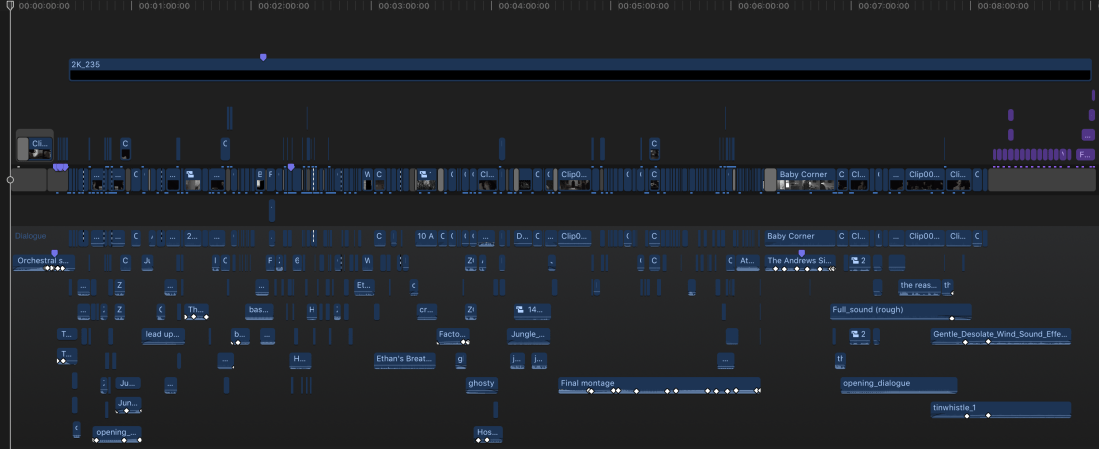
A great deal of my scripted sound design didn’t make it in, but what did makes me really proud. And today I was tasked with a scene that felt empty. A man is watching his wife cook only to turn and see something on fire. Right before he turns, I slowly faded in the noise of a bonfire that grew louder as he turned. But I couldn’t connect to the reality of the film in the way I wanted. The best I can describe it is by saying the scene had a texture like polished wood, but I needed a bumpiness to give me something to hold onto. I decided to focus on the eggs the wife is cooking in a pan. I found a great noise that worked well with the imagery but still stood out. And then I had an idea: why not fade the two noises together? Now the frying noise introduces and then disappears into the bonfire noise which fits the dreaminess of the scene perfectly. Here’s a picture of my timeline to make up for the wordiness.
I know, I know. I’m currently learning Premiere. Just be impressed I did this much with FCP.
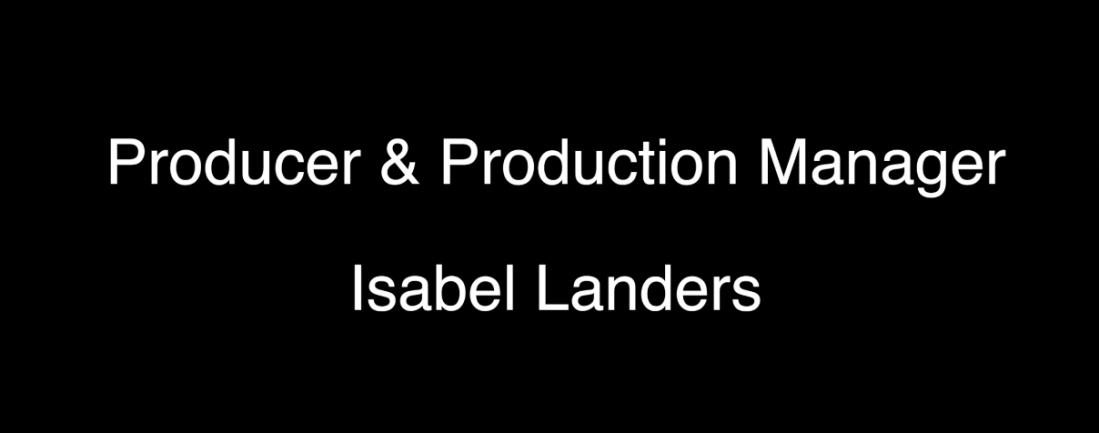
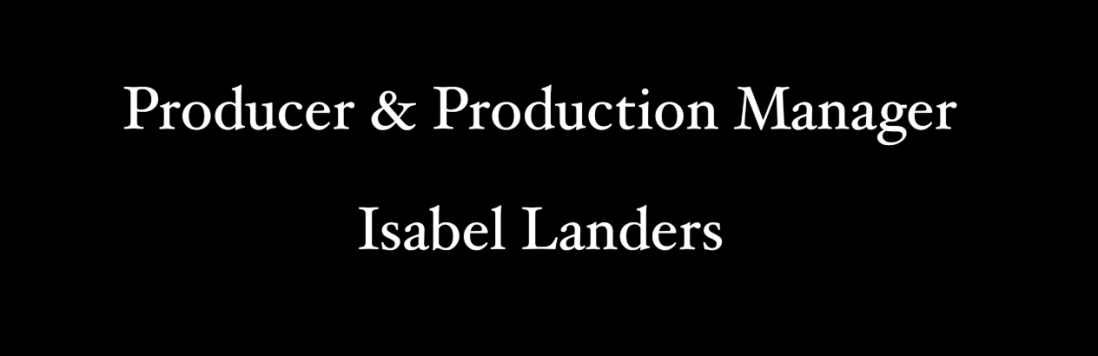
Other than that, I changed the font on my end credits. Helvetica is boring so I went for something more aesthetically interesting:
HelveticaHoefler
I think that looks better and I’m sure Isabel does too.
Next week, I need to fix some actual problems which will require more elbow grease than I currently have. I need to get some V.O. for characters who are supposed to be American military generals but sound more like college students. Oh well.
In the meantime, I’ll be re-watching Paddington and I hope you are too.
My name is Austin and I’m here to say, I love making films in a major way. Well, I’m here to say a lot of things. Ok so some essential things you should know about me before we start:
Eyesight : Perfect except for the whole Colorblind thing
Favorite Band : Radiohead
Favorite Video Game : The Beginner’s Guide
Favorite Color : Black
Proper Capitalization : What’s that?
Yep, that’s everything. I don’t know why either of us is still here since I just bared my entire soul. Did I mention I make films? Student films to be exact. (Sidebar: I think all films I make while being a student are probably considered student films and I’ve been a student basically my entire existence. Oh, wait, are you 21? Oh god, you don’t have your ID with you. We’ve got to leave this sidebar.) I started making films in high school with my friend who owned a camera. We made comedies and people laughed at them, but something was nagging at me. I grew dissatisfied with writing shorts that people chuckled at and then forget. So I dove headfirst into other genres and styles and decided I liked the whole film thing.
Fade To:
Int. Small, Rural Liberal Arts College – Present Day
I just finished my thesis film. It was a heckofa lot of work and there may or may not have been blood, sweat, tears, and pacts with the devil involved in its completion. I learned a lot and made the first film I’ve ever been satisfied with. (Although, it’s still a garbage fire in many ways.) Oh? What’s its modest title, you ask?
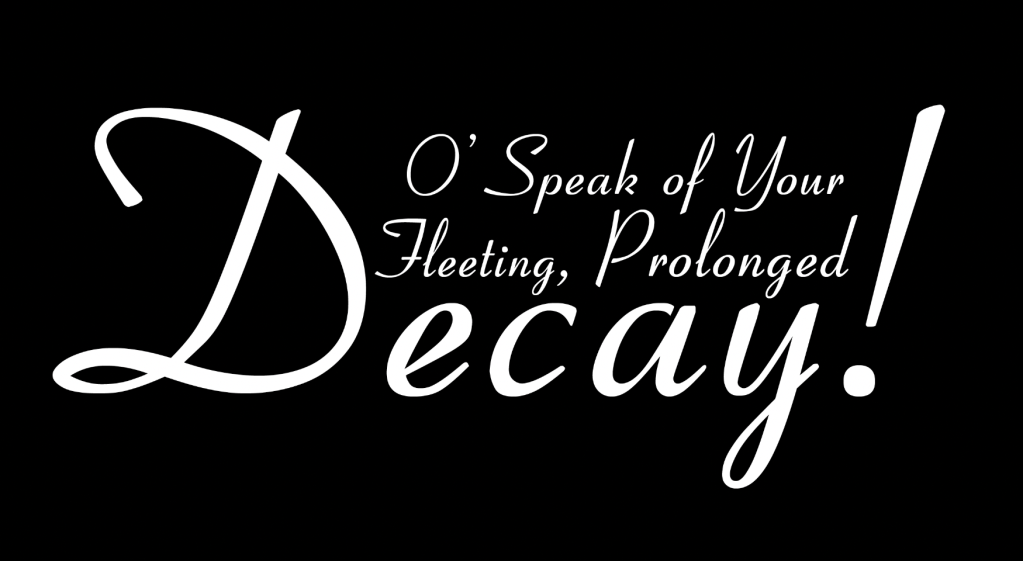
Go big or go home, some would say. Others just say it’s terrible but I choose to not listen to those buffoons. I should also mention that my friend Joey Schutz scored the film and collaborating with him was the most fun a boy can have. Anyways, enough gushing about my friends. I think this is a good place to leave you. I plan on tweaking my thesis a little before sending it out to festivals, so I’ll be sure to update you on that. Thanks for sticking around for so long.

 A Bigger Boat